Project Snapshot
Project Type
Hardware Dev · Electrochemistry · Signal Processing
Core Technique
Square Wave Voltammetry (SWV)
Target Analytes
As · Cr · Pb · Cd · Hg
Key Outcome
Comparable to commercial Sensit Smart device
My Role
Research Intern
Supervisor
Prof. Amit Acharyya
Project Overview
The Challenge
Heavy metal contamination in water bodies poses a severe global public health and environmental threat. Existing detection methods often rely on expensive, bulky laboratory equipment, limiting their accessibility for widespread, real-time monitoring in developing regions. There is a critical need for low-cost, portable, and accurate solutions for on-site heavy metal ion detection.
Our Solution
This project focuses on the design and development of a low-cost, portable potentiostat specifically engineered for the detection of heavy metal ions (Arsenic, Chromium, Lead, Cadmium, and Mercury) in water. Utilizing Square Wave Voltammetry (SWV), the system combines custom hardware with a novel data processing algorithm and user-friendly mobile and web applications to provide an accessible and efficient water quality monitoring solution.
Approach & Methodology
Potentiostat Hardware Design
Engineered a custom potentiostat circuit capable of performing Square Wave Voltammetry. Designed for affordability, portability, and robust signal acquisition for accurate electrochemical measurements.
Advanced Signal Processing
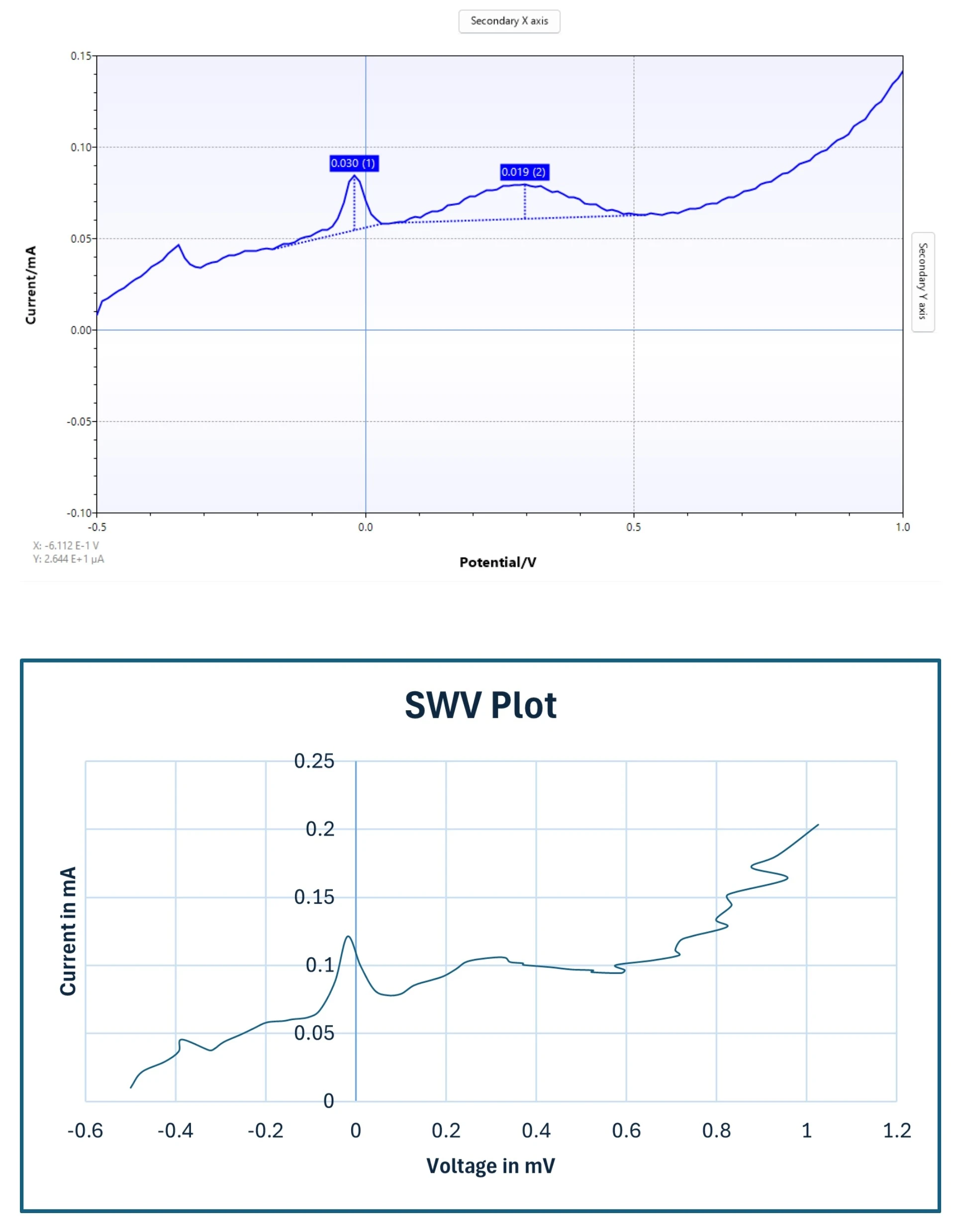
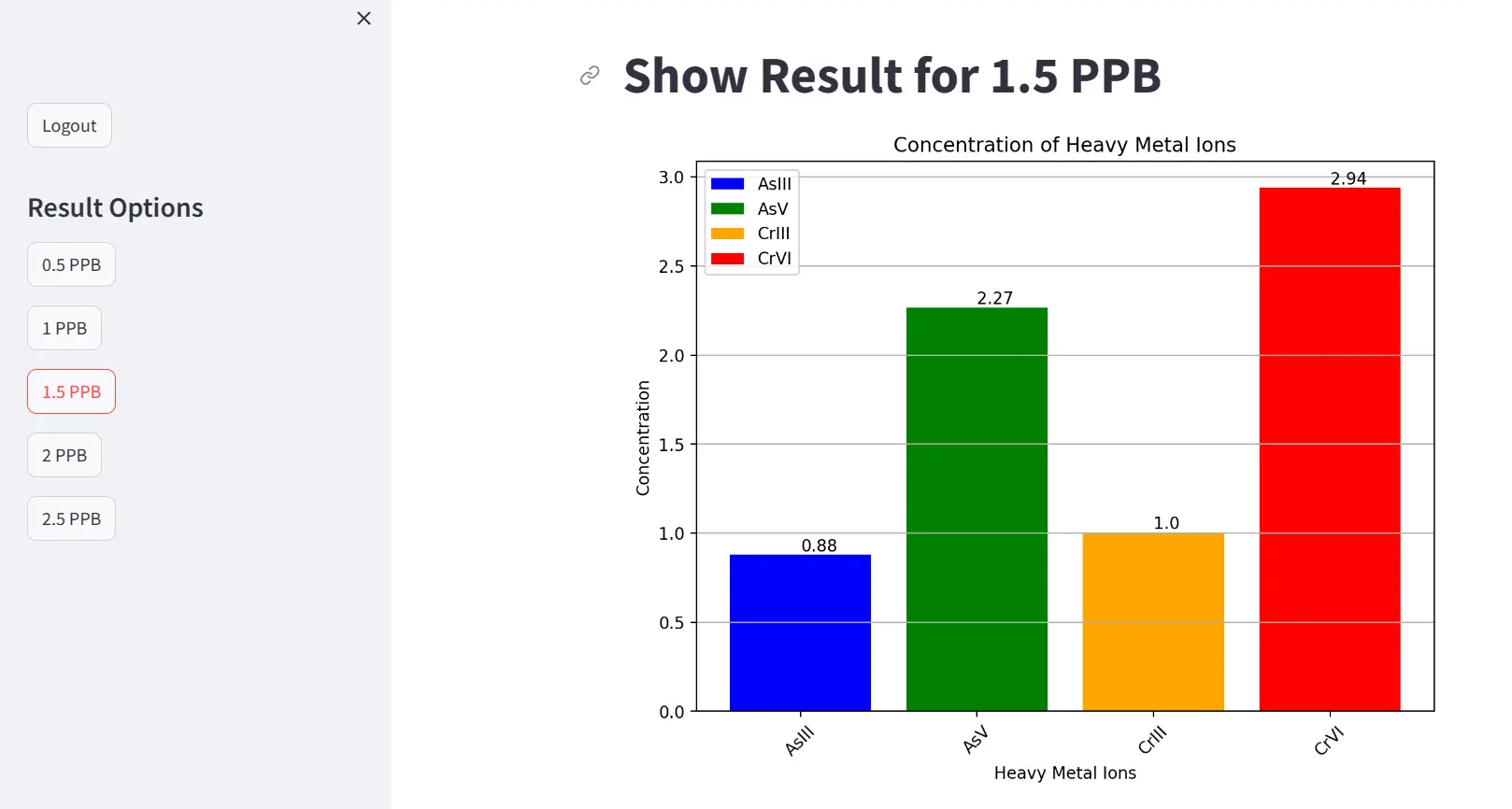
Developed a novel algorithm incorporating windowing and linear extrapolation techniques to precisely identify and quantify specific heavy metal ions by analyzing their distinct electrochemical SWV signatures.
Multi-Platform User Interface
Created intuitive mobile (Flutter) and web (Streamlit) applications enabling real-time data visualization, historical tracking, and simplified interaction with the potentiostat device.
Real-time Alert System
Implemented a Telegram-based notification system providing immediate alerts upon detection of toxic heavy metal ion concentrations, ensuring timely intervention.
Validation & Benchmarking
Rigorously validated the custom potentiostat's performance against commercial devices (Sensit Smart), demonstrating comparable accuracy. Validated using ADUCM evaluation board and Electrochemical Impedance Spectroscopy (EIS).
Key Results & Visualizations
Technologies Used
Lessons Learned & Challenges
Precision Analog Circuit Design
Ensuring stability and accuracy of the potentiostat's analog front-end was critical, requiring careful component selection and noise reduction techniques.
Signal-to-Noise Ratio Optimization
Optimizing SNR in electrochemical measurements at low ion concentrations was crucial for achieving reliable detection limits.
Algorithm Robustness
Developing a robust windowing and linear extrapolation algorithm that accurately identifies and quantifies ions across varying concentrations required extensive data analysis and iterative refinement.
Hardware-Software Integration
Seamless integration between custom hardware, ESP32, and mobile/web applications presented challenges in data transfer protocols and real-time synchronization.
Cost vs. Performance Balance
Striking the right balance between minimizing hardware cost and maintaining high performance ensures accessibility without compromising accuracy — a key insight of this project.
Future Goals
Future work aims to enhance capabilities for simultaneous detection of multiple heavy metal ions (Cr, Pb, Cd, Hg) by exploring a multi-channel chip array design. We also plan to further automate data integration and analysis processes, moving towards a fully autonomous water quality monitoring system for continuous environmental surveillance.
Read the Work
Published Research
This work has been published. Read the full thesis on ResearchGate.